



Suppose you are building a house and you want to know what will make you late.
You can raise the money in a week. You can order lumber and have it in a month. You can get the permit in a year, if the county cooperates. You can train an electrician in a decade. Concrete cures in 28 days, and it does not care who you are or what you paid.
Rank money, lumber, permit, electrician and concrete by how quickly you can get more, and you have ranked your risks. Money is last on that list. It is first in every conversation about the build.
The AI economy has the same five answers and one more. Ask what it takes to obtain one more unit of whatever is running short and the answers sort into six. Physical law, which never yields. Trained people and the slow work of reorganizing a company around them, 10 to 40 years. A stock that was accumulated once and is now being drawn down, which is data. Industrial production given capital and lead time, 2 to 7 years. A decision by people with the authority to make it, 3 to 24 months. And a price, days to weeks.
That ordering is the method. For any question, list the possible answers, work out how long the thing standing in the way would need at the rate it is actually moving, and compare that against the time left. What survives is the forecast. Only the first forbids anything outright. The rest make an answer late or expensive, which is why every verdict carries a probability rather than a proof.
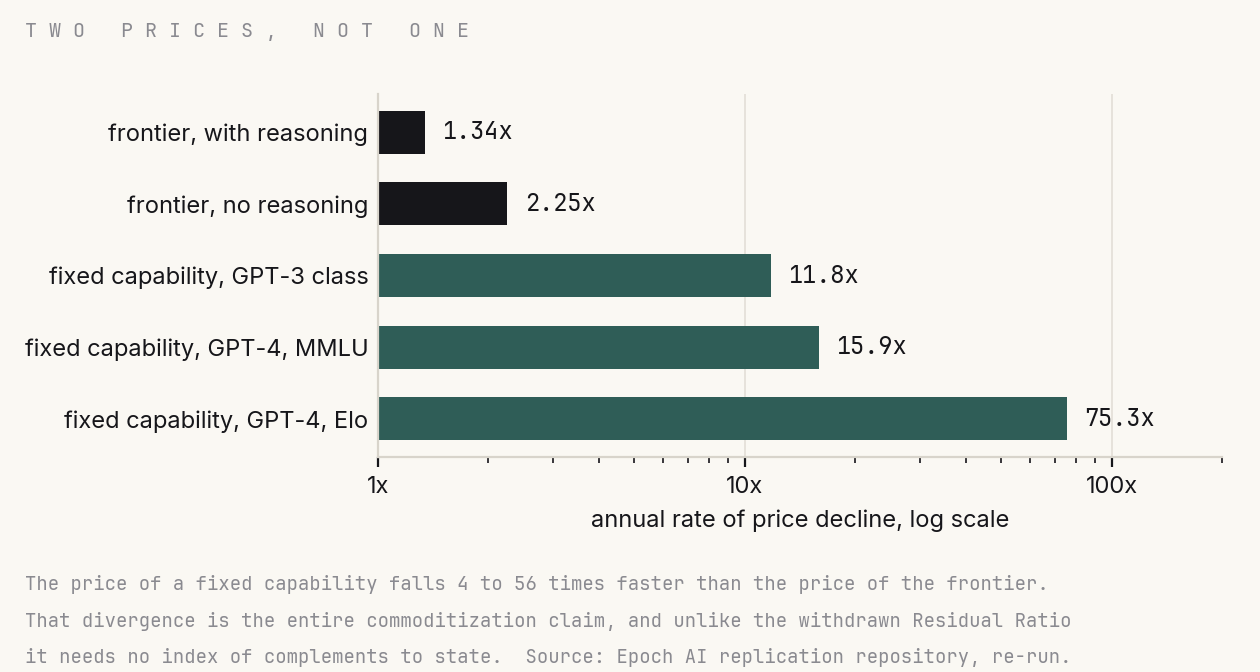
Once an AI model can do something, the price of getting that thing done falls about 12 times a year. The price of the best model available falls closer to twice a year. That gap, 4 to 56 times depending how you measure, is the engine of everything below: what collapsed is the price of any particular job, not the price of the frontier. The electricity, the memory and the factories under both collapsed not at all.
I asked thirty questions against that ordering. Every time I asked who gets paid, the answer moved down a layer.
One. The most-cited number in the AI debate describes the one input that was never going to be the problem, and it is being read wrong by a factor of seven.
The $1.5 trillion figure in circulation is a funding gap through 2028, closable by bonds, private credit, structured vehicles or equity. It is not a debt requirement, and the corresponding corporate issuance estimate is approximately $200 billion. Hyperscaler borrowing is expected above $400B in 2026 against roughly $165B in 2025, so the money is arriving. Capital relaxes in weeks and converts into every other input given time. It does not buy priority in a queue where every buyer has capital.
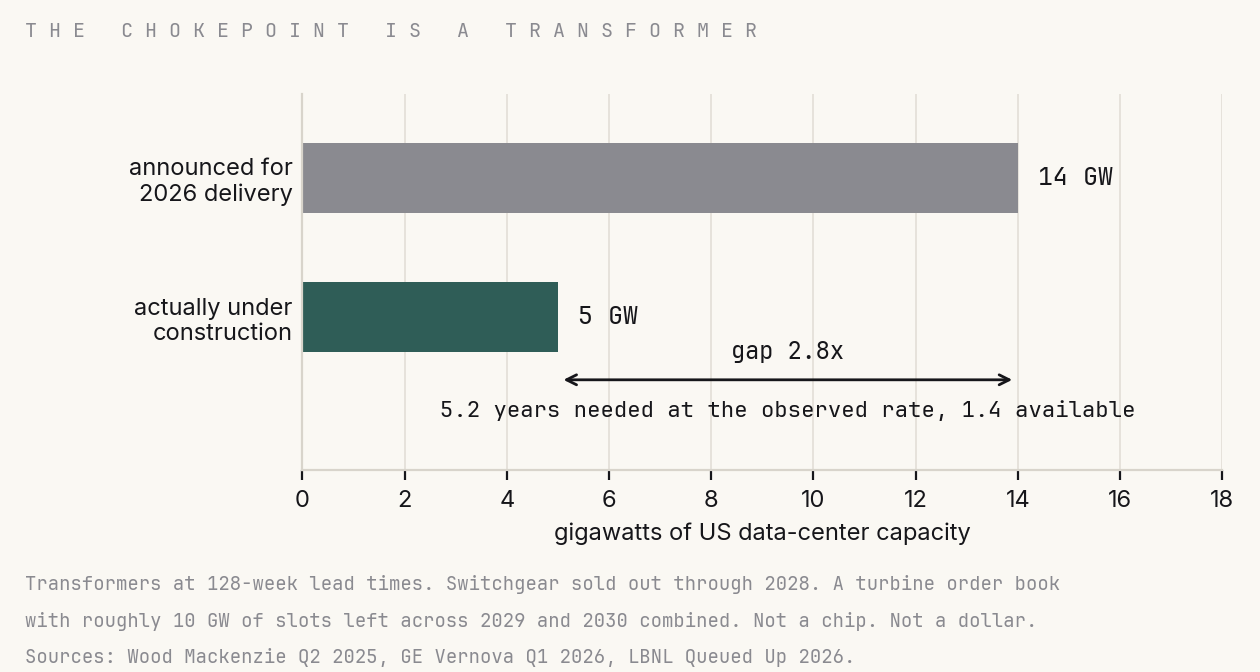
Two. The chokepoint is a transformer, not a chip.
US large-power transformer lead times average 128 weeks and reach 3 to 5 years for the largest units. Medium-voltage switchgear is effectively sold out through 2028. GE Vernova’s turbine backlog hit 100 GW in Q1 2026, with roughly 10 GW of slots left across 2029 and 2030 combined. Of the 12 to 16 GW of US data-center capacity announced for 2026 delivery, about 5 GW is under construction. Closing that gap takes 5.2 years at the observed rate, against 1.4 available. The largest buyer of accelerators says the same thing against its own interest: the chips are sitting in inventory for want of powered buildings to put them in.
Three. An instant productivity surge would take 70 years.
The scenario in which AI lifts output across the economy immediately needs 69.9 years of expansion in how fast organizations absorb new methods, against 4.4 available. Realized gains run at 0.1 to 0.2 percentage points against the 1.5 electricity delivered at its peak, and roughly 5 percent of integrated AI pilots are profit-and-loss positive. Electric motors were under 5 percent of factory mechanical drive in 1900 and the gains landed in the 1920s. Not because the motors were bad. Because the building had to be rebuilt around them, and the people who knew how to do that had to be hired, trained, and eventually put in charge.
Three questions, three different fields, and the answer moved down a layer each time.
Four. This is the weakest verdict I have, and it is the one I have already been wrong about once.
Public text runs out around 2028 on the median estimate, and training shifts to verified synthetic, multimodal and private sources. I hold that at 0.41, the lowest confidence in the set, and it should be low. Epoch moved its own exhaustion median from 2024 to 2028 while I was working, and its estimate of training data available by 2030, after quality correction, spans 400 trillion to 20 quadrillion tokens. The width of that interval is the finding. A wall you can walk around is not a wall, and this is the one place where I have already walked into that mistake at full confidence.
Five. Robotaxis are not waiting on the software. They are waiting on permission, one jurisdiction at a time.
The leading service runs about 500,000 paid rides per week across roughly 11 mapped metros, a fraction of a percent of trips. Ubiquity needs 15 to 40 times that footprint, which at the observed rate is 8.8 years against 4.4 available. What gates it is not autonomy. It is per-jurisdiction approval plus the mapping and validation each new market demands. The same input moves elsewhere just as unpredictably: the EU deferred the AI Act’s high-risk obligations by 16 months, and did it inside 7 months of legislative process. Nothing physical moves like that.
Six. Physics is the only constraint here that can forbid something outright, and it forbids nothing.
The thermodynamic floor on erasing a bit sits near 3e-21 joules at room temperature. Maximum efficiency for the silicon we know how to build is roughly 200 times what current accelerators deliver, and leading hardware improves about 40 percent per year. That is 2 to 6 orders of magnitude of headroom. The ceiling everyone reaches for is the one nobody is near. Every real limit here sits above it, in factories, queues, statute books and org charts.
One complication. Ask how much of the value is captured by anybody at all and the answer is about 30 percent. US consumer surplus from generative AI reached roughly $172B annually against attributable revenue several times smaller, and the rest accrues to users on things priced near zero. The investment argument this field is having concerns thirty cents on the dollar of value created. I expected that share to be falling, competed away by open weights. It rose from 0.27 to 0.31, and that hypothesis is withdrawn.
The other twenty-four
Same test, run on the rest. Rows marked [c] are computed against a rate you can go and observe. The other 22 are judgment, labelled as such rather than borrowing authority from the ones that are not.
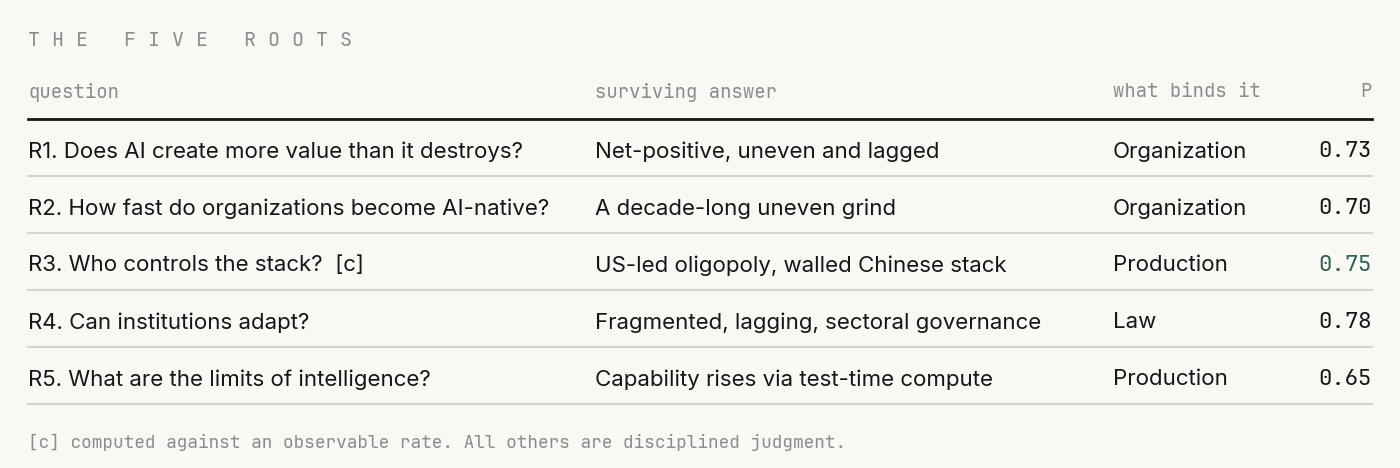
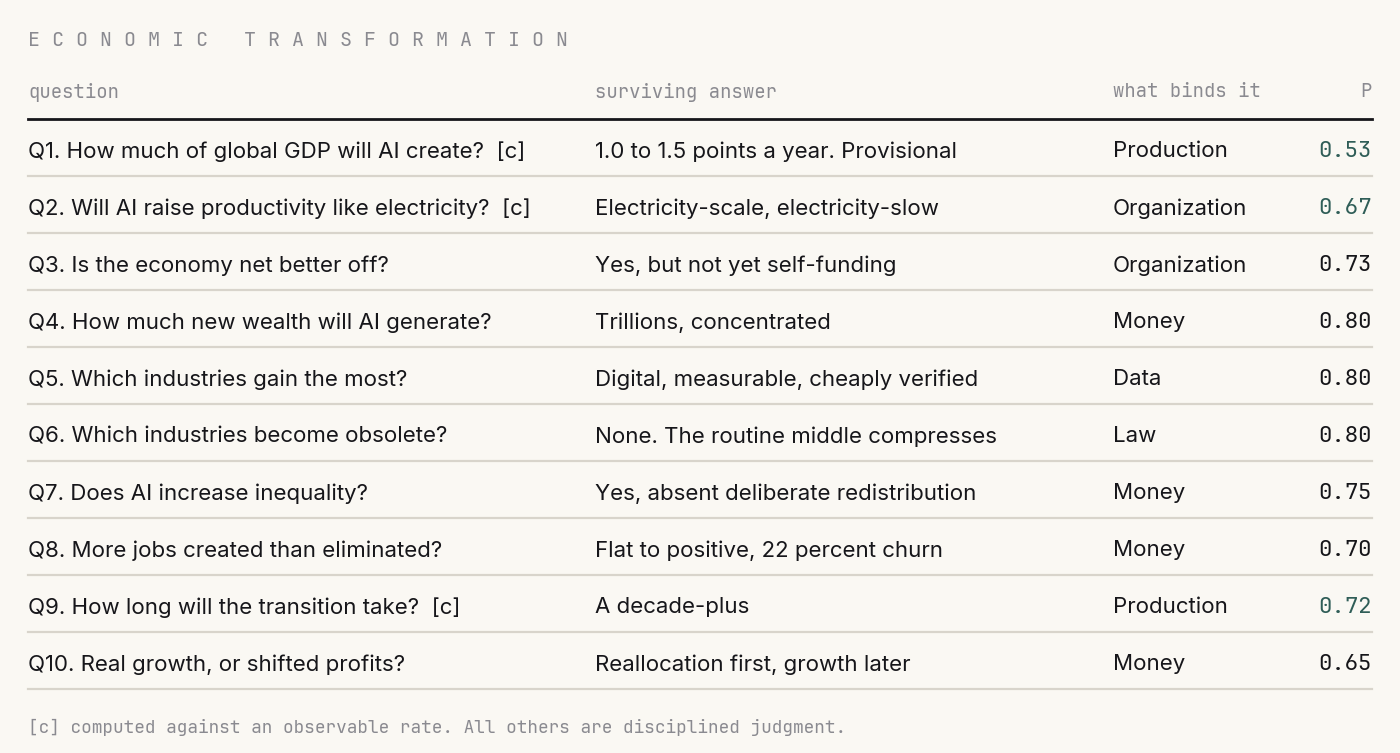
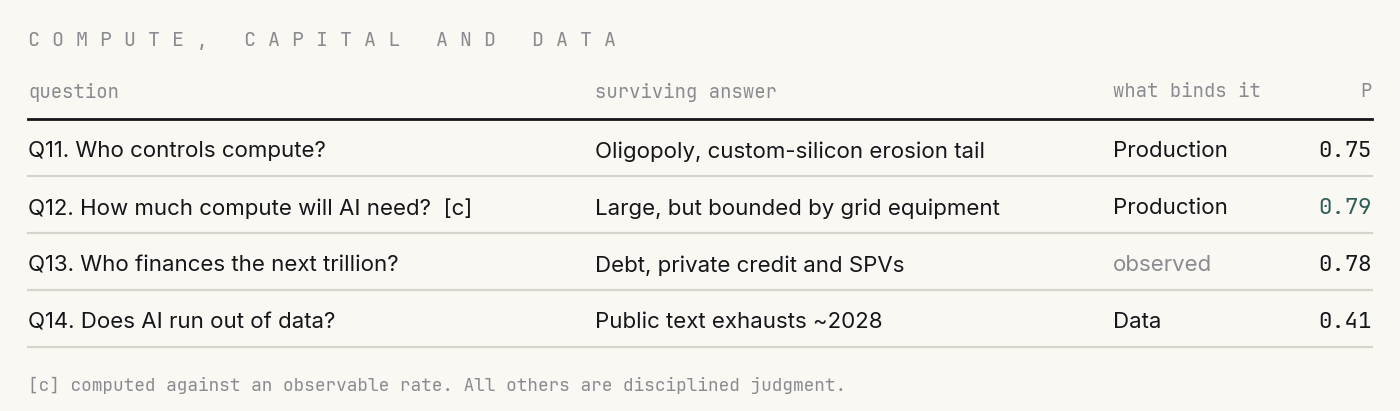
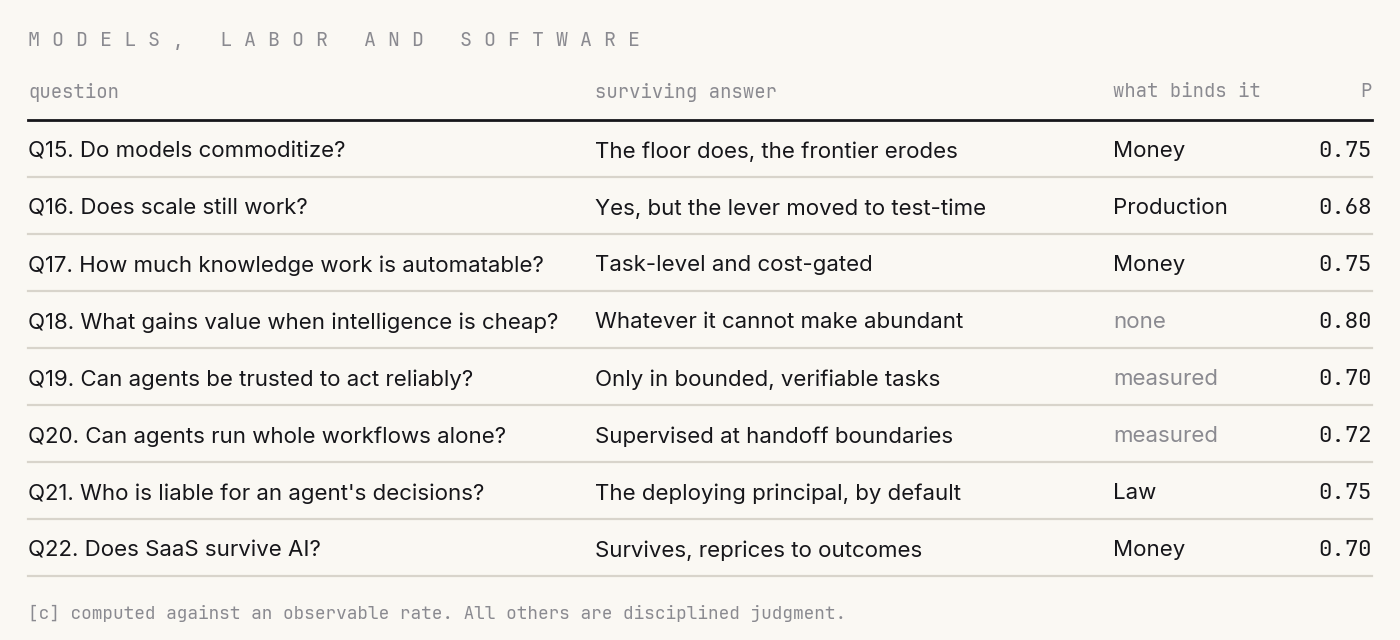
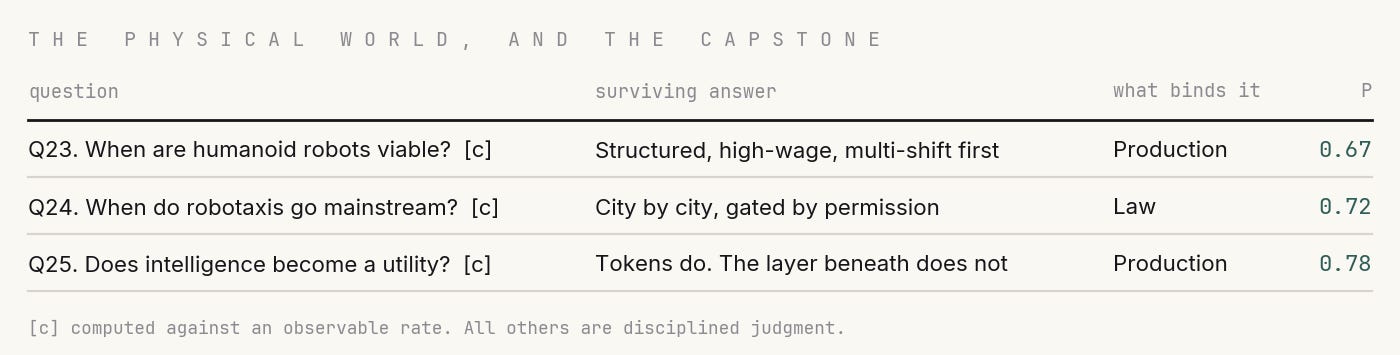
Two things in that column are findings rather than furniture. Organization and production bind 13 of the 30, more than any other pair: not data, which the field spent three years worrying about, and not money, which it argues about most, but the two slowest things on the list. And the probabilities cluster between 0.60 and 0.80. A forecaster whose every answer is probably is barely forecasting, and spreading that distribution is the next thing to fix. I would rather say it than have it noticed.
Economists have a word for the transformer, the memory, the permit and the accountable person. They are complements: the things that get more valuable as the thing beside them gets cheaper. I avoided the word for 1,500 words because the word does less work than the transformer does.
Where this breaks
A method that is only run where it flatters its author is not a method. So here is where this one fails, in four places.
It decides 8 of the 30. The test needs an answer whose requirement can be written as an expansion factor, and something in the way whose rate you can observe. Both exist for questions about future physical capacity. Neither exists for structural ones, like whether models commoditize or who bears liability, or for questions about the present, like whether agents are reliable today. So it is not a machine for answering everything. It is a test for which questions have physically determinate answers at all. Eight here do. Twenty-two do not, and confident disagreement about those is evidence about the forecasters rather than the world.
Its headline output depends on a number nobody has measured. Every forecast of AI’s contribution to output assumes some relationship between the compute you deploy and the output you can attribute to it. Nobody states it, defends it, or reports it, yet nothing else connects a forecast’s dollar figure to the compute the world can physically deliver. Computed from the actual series, it ran 1.70, then 1.17, then 1.37 across 2023 to 2026. PwC’s $15.7T is a bet on 1.7 or above, Goldman’s 7 percent of global GDP on roughly 1.4, Acemoglu on 1.0 or below. At the low end of the observed range my own GDP band is eliminated and Acemoglu is the only survivor. The central quantitative dispute in AI economics is a disagreement about one unmeasured number, and the question is currently underdetermined.
Its central measurement could not be built. Measuring how much value is captured at the physical layer required prices for four things: power, high-bandwidth memory, advanced packaging, and accelerators. None is constructible from public data. No vendor discloses memory average selling price. No published series exists for the delivered price of a data-center megawatt. Capture means margin, margin means price minus cost, and cost is undisclosed at every layer of this stack. Three attempts, three unrelated failures, which locates the fault in the question rather than the instrument. So the measure is withdrawn.
What replaced it runs on disclosed commitments instead of undisclosed costs. A constraint that genuinely binds attracts no supply response. A cycle does. Memory is responding: roughly $250bn of committed expansion at Micron alone. Power is not: four consecutive years of extraordinary prices drew approximately 525 MW of new resources into the PJM 2028/29 capacity auction, which cleared 6.8 GW short of target. Same test, opposite answers, both from filings. The money walked into memory and it did not walk into power.
It was wrong once, at maximum confidence, in public. Five questions were pre-registered with parameters fixed at their historical dates. Four correct, mean Brier 0.228 against 0.25 for a coin flip. The miss: it predicted at 100 percent confidence that running out of public text would stop frontier scaling by 2026. It did not. Epoch moved its own median from 2024 to 2028, and multimodal and synthetic sources substituted for a stock the model had treated as fixed. That is Malthus reproduced inside my own model, on the one constraint I had already named as most exposed to exactly that failure. Remove that single question and the mean Brier is 0.035, which is why the score is now reported by constraint and never in aggregate.
Two smaller admissions. The capture ratio rests on a revenue estimate far weaker than the surplus estimate it sits against, so the level is indicative and the second decimal is not real. And on eight computed verdicts the arithmetic moves the answer by less than 0.12, which is a prior wearing arithmetic.
What is actually staked
The widely cited measure of AI capability is the task length a model completes half the time, and it has risen several-fold since late 2025. The 80 percent number, the level at which you could hand work over and walk away, has been flat at 27 to 32 minutes across two release cycles. Capability is arriving as intercept rather than slope: models succeed more often on long tasks without succeeding more reliably on them. A system that finishes a 5-hour job half the time is not an employee. It is a lottery ticket somebody has to check.
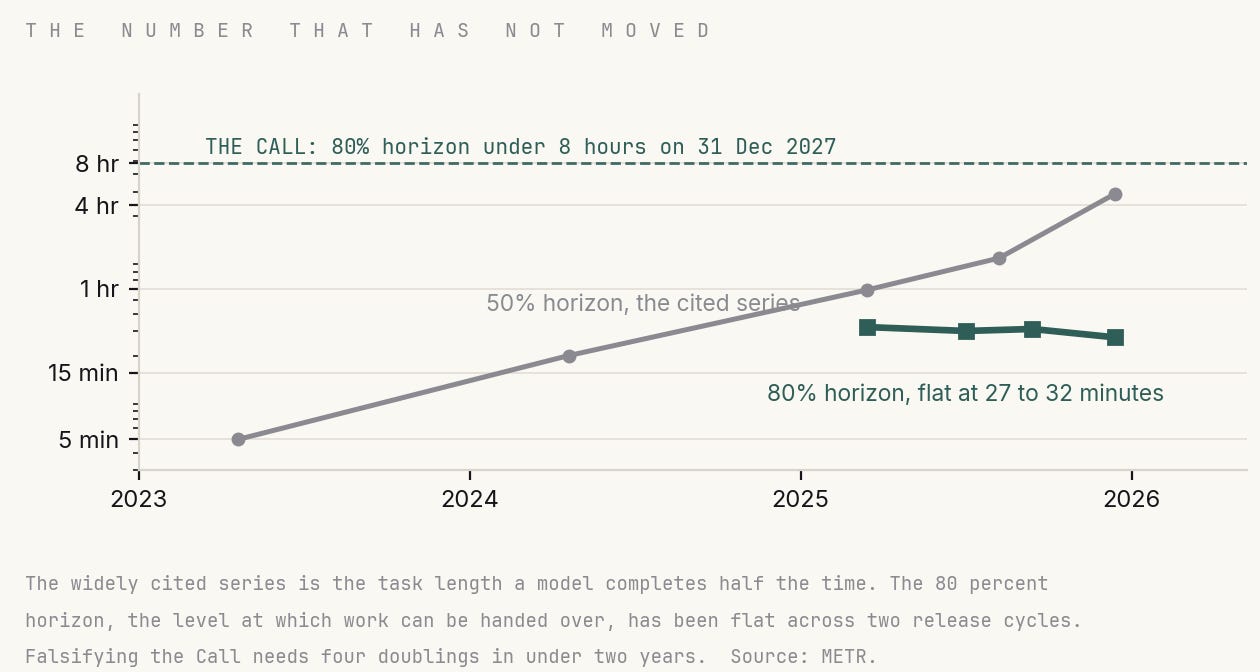
On 31 December 2027, the best generally available AI model’s 80 percent-reliability task-completion horizon is under 8 hours. (Probability 0.85 · Adjudicated 31 March 2028 · Five rules and a void condition specified in full)
Falsifying that requires a sixteen-fold rise, four doublings, in under two years, in a series that has not moved across two release cycles.
A second bet is staked on the thesis directly, and it is hard. Combined high-bandwidth-memory revenue at SK hynix, Samsung Semiconductor and Micron for fiscal 2027 exceeds combined total revenue at the two leading frontier laboratories for calendar 2027. Probability 0.55. Both sides are reported figures, because a bet you cannot settle is not a bet.
Three other things would do real damage. US productivity growth holding above 2.5 percent for three consecutive years with credible attribution to AI kills the electricity-slow verdict, and it reached 2.7 percent in 2025. PJM or an equivalent market clearing an auction with substantial new entry at or below the price cap kills the classification of delivered power as a hard constraint, the deepest floor in the argument. And that unmeasured relationship between compute and output settling outside 1.2 to 1.5 for two years resolves the GDP question either way.
One objection I grant rather than answer. If the terminal constraint is organizational rather than physical, the money accrues to whoever solves adoption, not to whoever owns the transformer, and the investment conclusion inverts. That is what happened with electrification. So the claim is bounded to the window where physical constraints dominate and absorption has not had time to bind: 2026 to 2030. Past it, I do not make the claim.
Plenty will have changed by 2030, and the changes that matter most are the ones hardest to see now. But the ordering above is dated to the week, and it holds today.
Superintelligence may or may not arrive on schedule; the electricity bill, the memory, and the trust will arrive regardless.
The full memorandum runs 60 pages: 30 verdicts, 19 tracked signposts, a scored backtest including the miss, and a published reproduction repository.
Read it: https://www.theashbyinstitute.org/publications/via-negativa
It has not been externally reviewed. Readers who find an arithmetic error are invited to report it, and every report will be logged publicly whether or not it changes a verdict.