


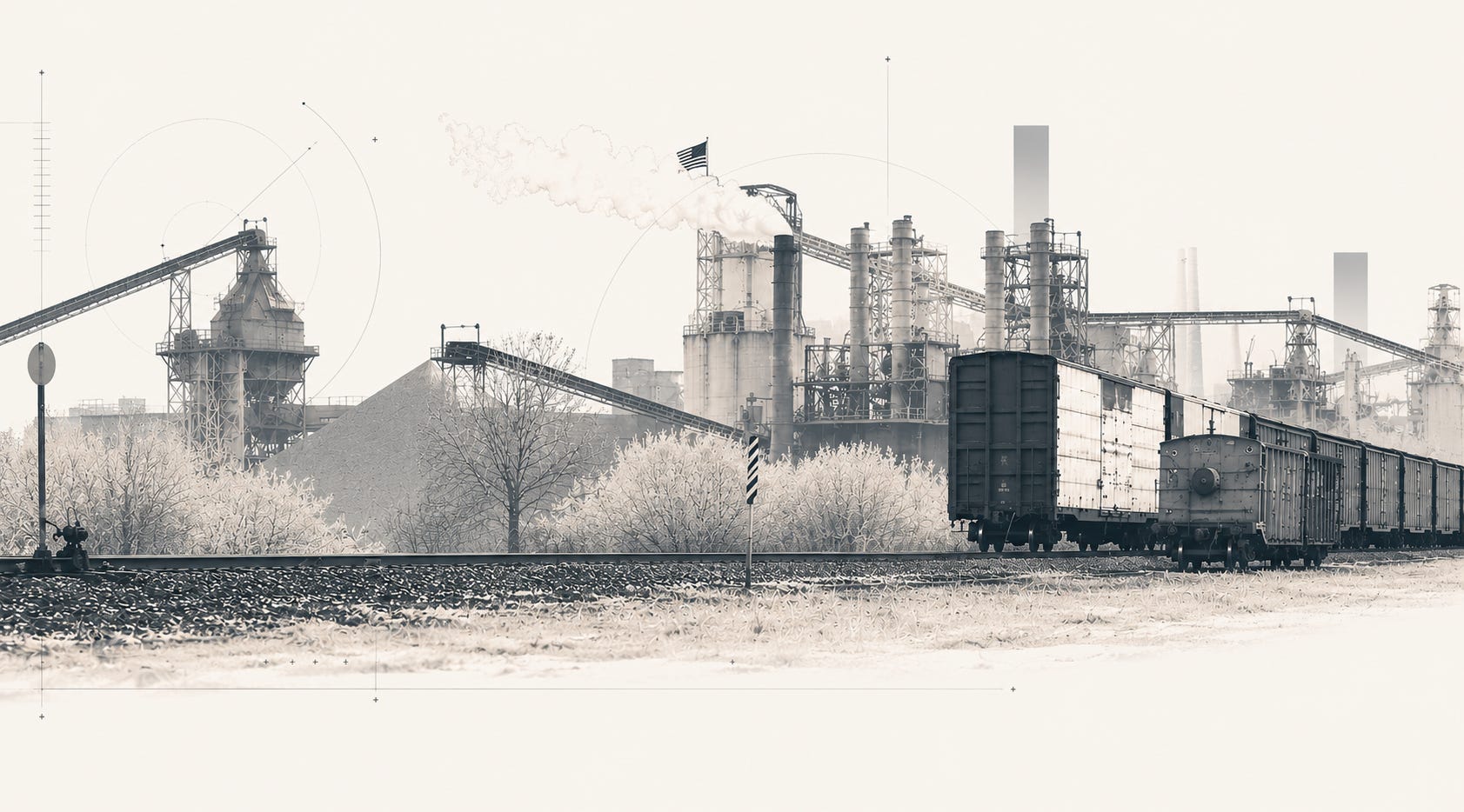
In 1954, the Atomic Energy Commission chairman vowed an era in which energy would be "too cheap to meter." He referred to the atom then. He could as easily have referred to intelligence.
For four centuries the ideal of civilization had been mind over matter: human reason compelling material reality to follow its command. That ideal is waning, and a new and eerily different one is rolling in to take its place. The command is no longer ours alone; we no longer own the whole of intelligence. The material world is no longer solely the passive object of thought, no longer the thing that obeys it; it has begun to form its own mind, and now follows its own agenda faster than any institution built to govern it can catch up to. Neither dominates the other anymore; they meet as equals. Where they meet is the ground that decides everything, and it is the ground almost no one is watching. I built this to watch it.
This is what I believe, and why I built this publication: for demonstration, and for open criticism.
The trend for intelligence is toward free. It is July 2026 as I write, and the best model on the most prominent public leaderboard is open, not closed; the gap from first to tenth narrows with each update; machine intelligence falls in cost each passing year at a rate that would terrify any other industry. This is not a failure of the technology. This is the path laid out for a technology as it becomes infrastructure. And infrastructure obeys one law above all: the abundant input never takes the margin. The margin goes to whatever is scarcer than before.
The story of value is a story of scarcity. It is about what becomes valuable once the formerly scarce thing turns abundant and nearly free. Ice was once a precious resource, cut from frozen lakes and shipped by the pound to homes without refrigeration. When we invented the fridge, we made ice limitless and practically worthless. We did not stop paying, we simply paid for cold on demand, forever, pulling the value out of the ice itself and into the power of the refrigerator and the cold chain. The value did not collapse in the face of abundance; it relocated to where scarcity remained. So it goes now with intelligence, and the relocation is the whole story. This time the scarce complements are many: the power to run the models, the memory and fabrication to build them, the verified data to feed them, the trust to deploy them, the control to govern them, and the human agency they threaten, in some small part, to hollow out.
To be clear, I refuse to pretend the physical economy of intelligence is the whole story, because it is only one side of the coin. The other side is intelligence itself. I watch both sides, and I will not watch one alone. Matter is everything beneath today’s intelligence: power, silicon, memory, data centers, rare earths, robotics, the industrial base without which no digital mind can survive. Mind is what we do with it: models, cognition, world models, interpretability, alignment, and the autonomous agents now acting on the physical world with no human in the loop. To watch only the matter is to miss where the intelligence is going. To watch only the mind is to forget there is a material side, and that we live on a finite planet. The subject is the meeting. Always the meeting.
There is one discipline I hold above every other, and it is not a field but a standard. I reason from first principles, and I test every claim against the limits that bend to neither capital nor cleverness: energy, capital, matter, data, law, and time. Where others give me a vector, I require a number. Where others offer a judgment, I require a prediction with a date on it and a public scoreboard that grades it before the world. I will not accept a prediction that cannot fail, because a prediction that cannot fail is not a prediction. It is a mood. Every claim I make here is entitled to fail, and when it does, it will tell you exactly where and how. At a moment of near-universal certainty, in which the optimists and the pessimists have both dug in and refused to be moved, I make the least fashionable bet on the table: that the plain, quantified, checkable claim, held long enough to be vindicated or falsified and withdrawn, is the last and highest thing of value anyone can offer.
No single field can claim this collision, because it is thermodynamic and economic and cybernetic and political all at once, tightly coupled and racing forward. So I reason from many, held as equals: econophysics and cybernetics, systems engineering and information theory, thermodynamics and behavioral science, and the discipline of aligning not one machine but a civilization of them. To these I add one framework of my own, Autonomous Cyber-Physical Macro-Dynamics. Ten thousand self-driving cars are not ten thousand cars. They are a flow, and a flow can jam, surge, and ripple in ways no single car is doing. When autonomous machines act by the millions in the physical world, the swarm becomes an object with laws of its own, and those laws have gone unstudied. Eight lenses, one collision, one standard of proof.
None of this is only about where to invest, though I will tell you plainly that it is about that too. Pull the lens back and the same instruments expose the fault lines that could stall or break this century, precisely because they are the fault lines no single discipline can see. Our capacity to build systems has outrun our capacity to govern them, and only variety can absorb variety. An exponential digital mind is being run on a finite, aging grid, and energy is already the binding constraint. Alignment is studied one model at a time. But a market crash is a crowd of traders each following their own rules correctly, and crashing anyway; the failure lives in the crowd, not in any one trader. A civilization of AI agents is the same. Millions of them, each behaving exactly as built, can still interact into an outcome no one chose and no one wanted, so that the whole fails while every machine inside it runs in perfect accord. These are not prophecies of doom. They are the engineering problems of our age, stated at the size they actually occupy, and I hold, with some conviction, that they cannot be understood, priced, or governed one discipline at a time.
Here is what Mind Meets Matter will be. I will write across both sides of the collision, the physics and the intelligence, without flinching from either. I will publish a number where the field publishes an adjective, a dated call where it publishes a mood, and a public scoreboard that keeps me honest. I will build a permanent library of the frameworks I reason with, so the work compounds instead of repeating itself. I will sit down, on the record, with the people building, funding, running, and studying this economy, and I will open each conversation on a constraint and close it on a claim that can be checked. And I will show my work, disclose my interests plainly, and correct the record the day I am wrong.
This is for the people who live at this frontier and are tired of reading about it from people who have never stood on it: the founders and the investors, the operators and the researchers, the scientists and the engineers. Much of what appears here begins in conversation with you.
Three pieces lay the foundation, and they are the place to start:
Via Negativa: The AI Economy by Elimination, a forecasting memorandum that predicts the AI economy by elimination, with its live signpost tracker.
Compute 2030, a scenario forecast for the compute transition through the decade.
The Missing Meter, on why there is still no standard unit for pricing intelligence, and why the meter is the moat.
Attention is the new capital, and I intend to earn it the hard way, which is the only way that lasts: by being right, on the record, about the thing that matters most. Not what intelligence can do. Where it meets what it cannot change. The value is under the model. Come find it with me. Subscribe; it is free.
One disclosure, kept in view: I build and invest in some of the markets I write about, and I say so wherever it is relevant.
Mind Meets Matter. Where intelligence meets its physical limits.
Congratulations on shipping. A public scoreboard of dated, numbered predictions is rare, and useful if kept. I'll check it in Q1.
This is incredibly well written. In many ways, it captures something I have wanted to articulate for a long time, but never with this level of depth.
I’m deeply interested in what happens when intelligence enters the physical world. I believe the potential is enormous for how the entire world operates.
That is also why I have committed myself fully to this field. I’m not focused only on robots or any single technology. What interests me is the broader transformation that will happen as AI begins to perceive, act, and make decisions in the physical world, and the profound impact this will have on industries, society, and the systems around us.