


Two months ago I published The Missing Meter and said AI has no instrument for what inference actually costs. Then I built one. Here is the first reading.
The same AI model costs up to 18x more depending on who sells it to you.
Closed models have one price everywhere. Open models have as many prices as sellers.
One seller offers Llama 3.1 8B at $0.022 per million tokens. The GPU alone costs $0.070 to rent.
18x
tokenprice reads every endpoint on OpenRouter and the labs’ own pricing pages once an hour. 82 providers. 447 models. 156 with two or more sellers. Every row carries its source URL and the minute it was read.
Same model. Same quantization. Same context window. Cheapest seller collapsed per provider so premium tiers cannot inflate the number.
deepseek-v4-flash: 13 sellers, 18.4x max/min, 8.4x p90/p10
glm-5.2: 23 sellers, 12.3x, 4.3x
gpt-oss-120b: 22 sellers, 11.5x, 4.9x
glm-5.3-flash: 37 sellers, 7.5x, 2.0x
qwen3.6-35b-a3b: 10 sellers, 16.9x on one outlier listing, 1.9x p90/p10
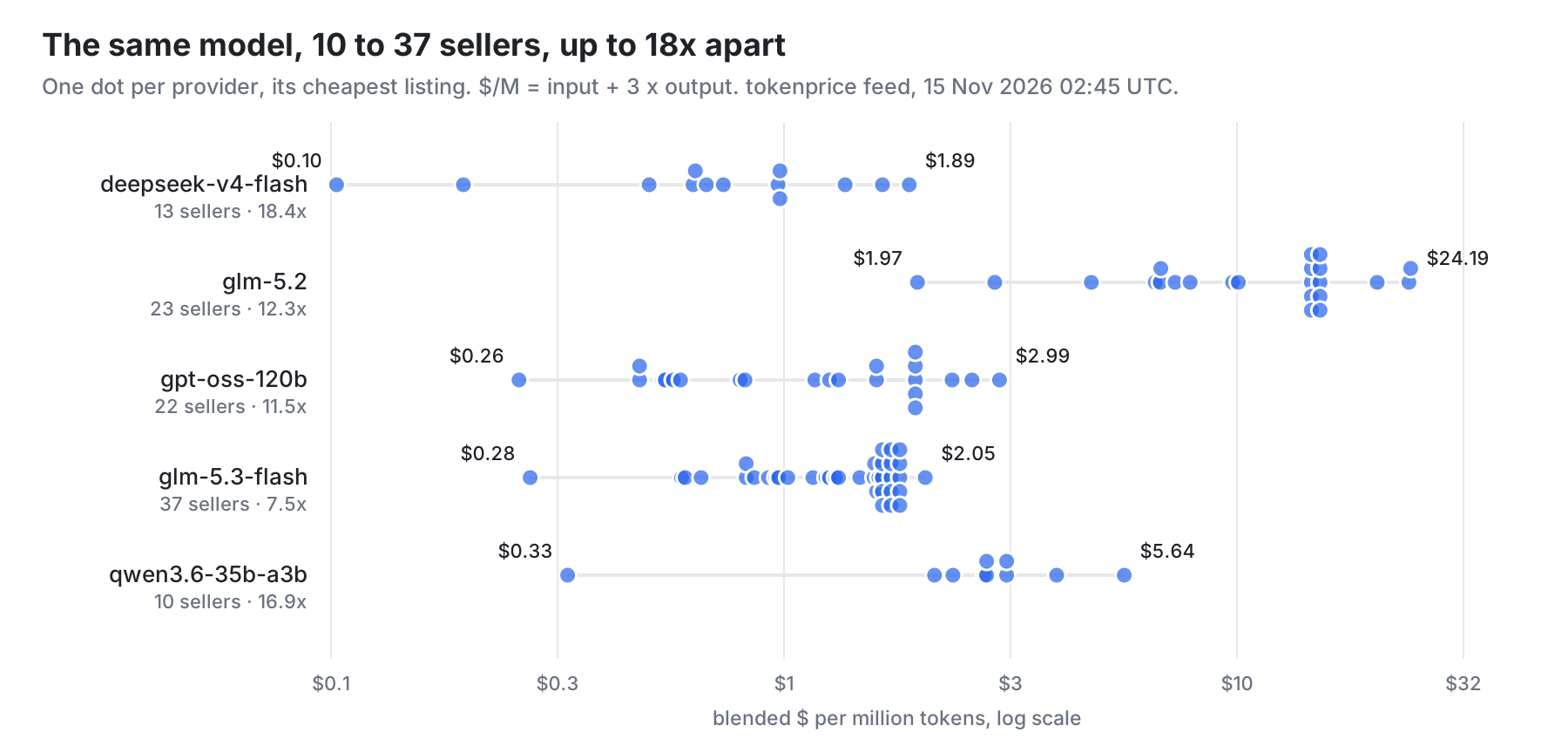
Feed read 15 Nov 2026, 02:45 UTC. The p90/p10 number is the one to trust: it ignores the single cheapest and single dearest seller. deepseek-v4-flash is 8.4x apart between its 10th and 90th percentile sellers. That is not an outlier, that is the market.
Two days earlier glm-5.3-flash read 14.9x. A seller moved and it is now 7.5x. That is the other reason the feed is hourly: a one-day snapshot of this market is wrong within 48 hours.
The paper said 8.6x, from a reconstruction. The measured number is bigger, and every row of it is sourced.
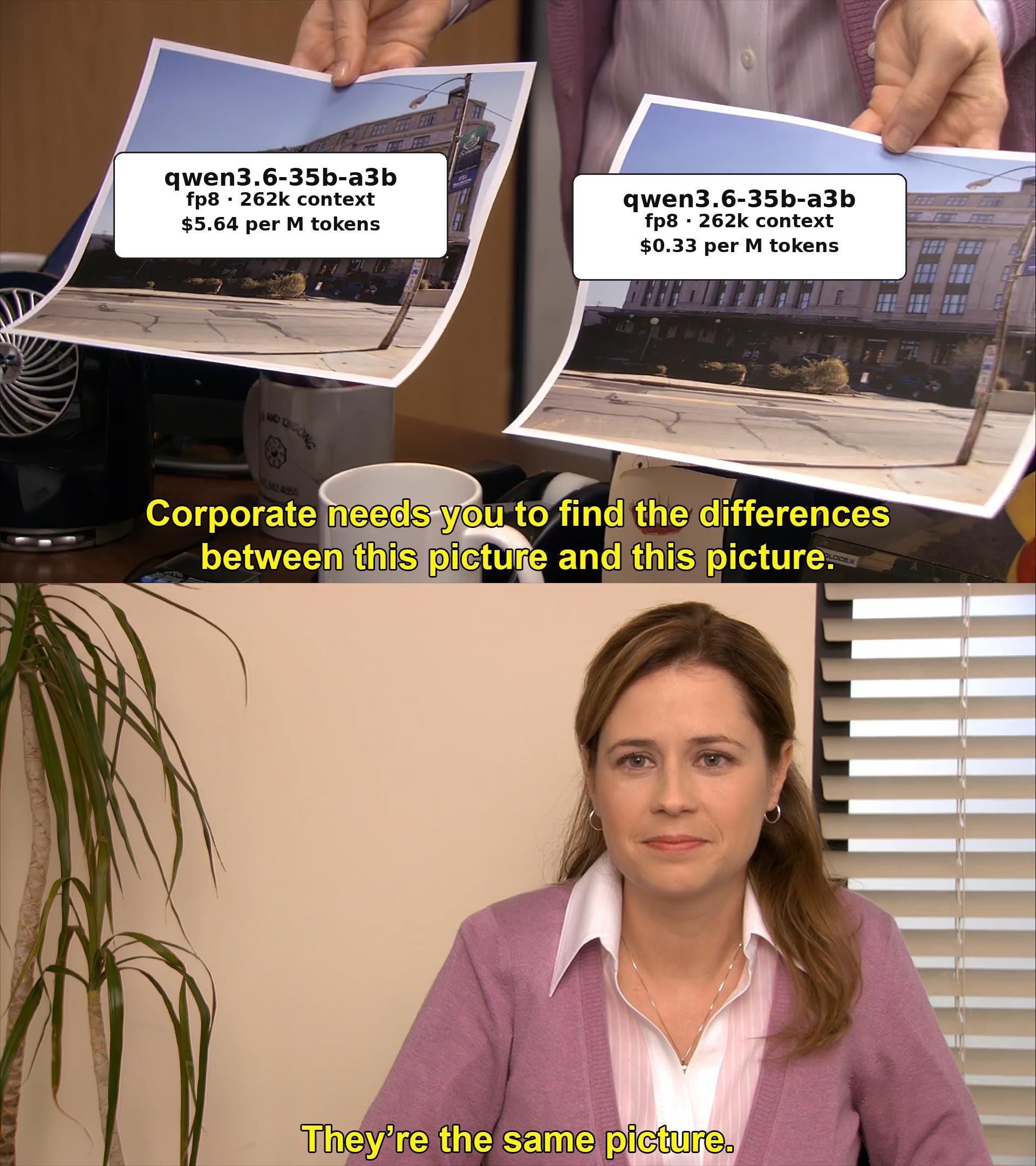
The qwen row is the one to watch. Nine sellers between $2.15 and $5.64. One, primeintellect, at $0.33 for the same fp8 build. That is a price or a typo. It has now held for two days of hourly reads. Typos get fixed; prices persist.
One price, or thirty-seven
I pointed the feed at Anthropic’s, OpenAI’s, and Google’s own pricing pages and checked every reseller of every model against list. 57 models: 16 Claude, 27 GPT and o-series, 14 Gemini. Bedrock, Azure, Vertex, AI Studio, OpenRouter.
Zero off list. Every deviation is a published multiplier: the lab’s own speed or batch tier (Anthropic fast 2x; OpenAI batch 0.5x, fast 2.5x, ultrafast 6x; Google batch 0.5x, priority 1.8x) or the cloud’s documented regional surcharge (Azure regional 1.2x, Bedrock and Vertex regional 1.1x). The one row that looked like a 1.54x markup was gpt-4o-2024-05-13, a dated snapshot still sold at its launch price, which the page does not list. Different product, not a markup.
Open-weight models in the same feed, the same hour: 18x.
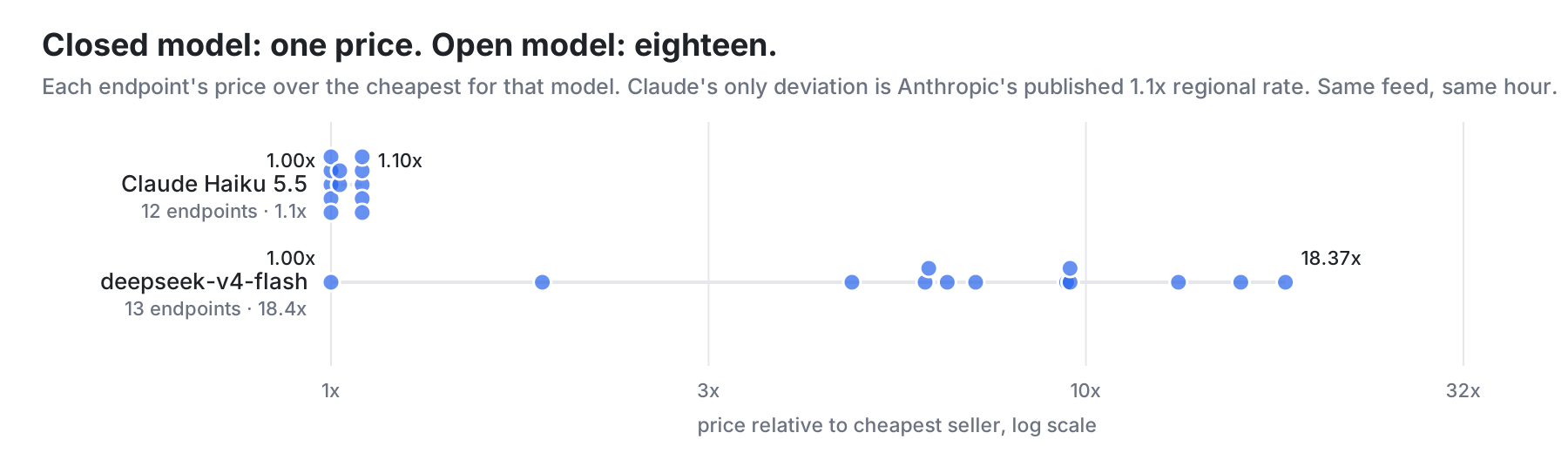
These are two markets wearing one API. Closed models are priced by the lab; resellers are distribution and the price tells you nothing about cost. Open models are priced by whoever has idle GPUs this week, and the price tells you everything. One is an administered price. The other is a spot market. Anyone fitting a trend line to “the cost of inference” is averaging the two, and getting neither.
Below the floor
Dispersion tells you prices disagree. It does not tell you who is right. For that you need a cost floor, built from measured timings, not spec sheets.
token-margin joins tokenprice to the Reckon measured corpus: time to first token and time per output token on six GPU types, batch sizes to 32, recorded by sounding, Reckon’s measurement tool, which by design never imports the estimator it checks. GPU rates are the RunPod rates I actually paid. The floor is GPU-hour only. No CPU, no network, no staff, no failed requests. The lowest number anyone could defend.
The corpus has been through one adversarial pass already. mismatch-tax, pre-registered before it ran, found TTFT and TPOT internally consistent across 150 configurations on five accelerators, every one memory-bound where the roofline says it should be. Its first result was a falsification: the corpus’s own bandwidth microbench was wrong as a decode ceiling, filed as Defect 17. The timings survived. The ceiling did not. Those timings are what the floor is built on.
Four hypotheses, written before the analysis ran:
H1. Nobody prices below the rented floor. Falsified. deepinfra sells Llama 3.1 8B at $0.022/M. Floor on the cheapest silicon is $0.070/M (MI300X at RunPod list). It never breaks even on rented hardware at any batch size the corpus reaches.
H2. Price spread exceeds hardware spread. Confirmed. Llama 3.1 8B sellers span 9.9x. Floors for it across five silicon types span 3.2x. Hardware explains a third of the spread at most.
H3. Median margin above 50%. Falsified. 36% at 60% utilization. Negative at 30%. On rented GPUs this is a thin business.
H4. Quantization orders price. Not tested, n=4.
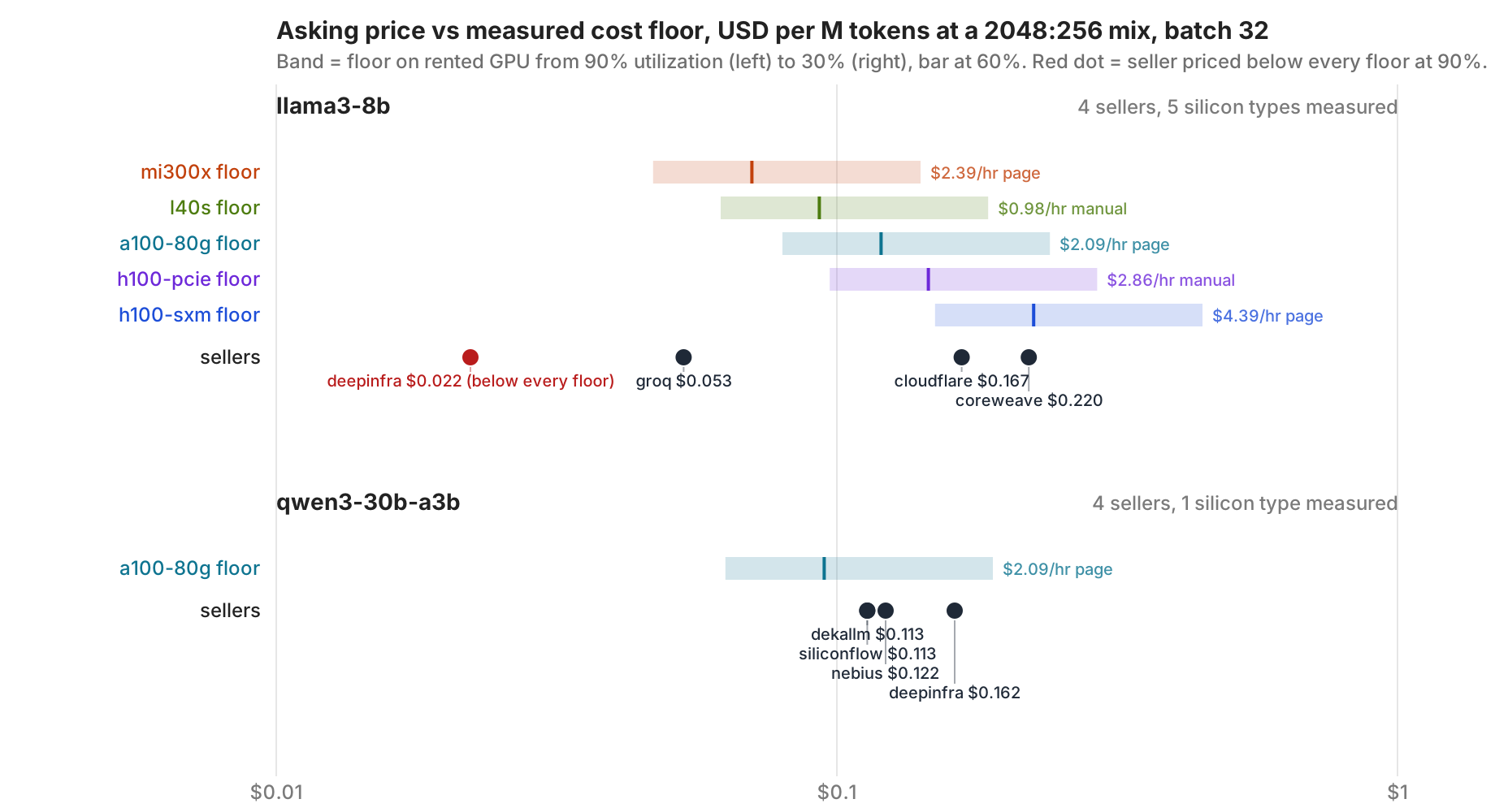
One objection first, because it is the right one. The floor is measured under vLLM, and the Mismatch Tax paper’s Table 1 shows vLLM leaves 17% to 55% of each card’s spec bandwidth unused, median per card. So the floor contains software waste. Strip all of it out. On MI300X the median gap is 46%, so the zero-overhead roofline floor at batch 32 is $0.038/M. Deepinfra sells at $0.022. Below the physical limit of the cheapest rented card at the largest batch the corpus measured, not just below what one serving stack reached on it.
Two things could still explain it. Owned hardware: the price works if the GPU costs about $0.74 per hour under the measured stack, roughly $1.40 with perfect software, against $2.39 to rent the card. Or batch sizes well past 32: an 8B model at bf16 is memory-bound, so the per-token floor keeps falling as batch grows until compute binds. A seller running batch 128 on owned silicon could clear it. Either way the price is not a rented-GPU price, and nothing on the listing tells you which.
The meter, two legs of four
The paper said the meter AI lacks has existed since 1988. TPC prices useful work with four things: a price, an audited cost basis, an enforced deadline, a correctness floor. The deadline leg is where the money is: Reckon’s served token, one output token delivered inside its deadline and above its quality floor, puts two services on identical weights at $1.06 and $41.86 per million. 40x, from workload shape alone.
Price: built. Hourly, sourced, public.
Cost basis: built, narrow. Measured floors, n=4 sellers per model.
Deadline: prototyped. mismatch-tax ships a served-token dispatch solver over measured timings; prices still placeholder.
Correctness: not built.
Two legs took one person two months. The other two are where cost-of-useful-work lives, and that is Reckon’s stack: berth predicts what a workload costs on a given accelerator before you rent it, sounding measures the real thing, pilot moves the workload when prices or capacity shift and proves what the move saved. Code and docs at github.com/reckonresearch/reckon and docs.reckonresearch.com. A price feed with a deadline column is next.
How to prove me wrong
Stale listings. If the dearest deepseek-v4-flash sellers show zero uptime in the feed, the 18x shrinks. The uptime column is in the data. Filter it.
Primeintellect is a typo. Thirty days of hourly reads will say. The history file is public.
My floor is too high. The corpus stops at batch 32, and the floor falls past it. Bigger batches, better kernels, speculative decoding all lower it, and the same corpus has seen a 2x swing on identical hardware from serving-stack version alone. The spec-roofline check above closes the kernel argument at batch 32; it does not close the batch argument. Phase 2 measures batch 64 to 256 on gpt-oss-120b and qwen3.6-35b-a3b, 22 and 10 sellers. If you run inference and your floor beats mine, send the number and the batch size.
I only saw OpenRouter’s resellers. 57 models from three labs, but only the resellers OpenRouter lists. A cloud or broker discounting a closed model off-list outside OpenRouter would not appear. Name one. Also: Google’s pages carry launch promos with end dates (Gemini 4 Carbon doubles on December 1). The feed tracks the price in force; if resellers lag the rollover, that will show as a brief discount and I will report it as what it is.
Sources
OpenRouter models and endpoints APIs, hourly, URL and timestamp per row
Anthropic, OpenAI, and Google pricing pages, parsed hourly
My RunPod invoices, July 2026
RunPod list page, 12 Nov 2026, for GPUs I did not rent
Reckon measured corpus, July 2026
tokenprice · token-margin · reckon · berth · agent-cost · awesome-ai-compute-economics · The Missing Meter (PDF) · reckonresearch.com
I would rather be wrong in public with data than right in private without it.