


“My answer would be reliability.”
Ilya Sutskever, co-founder of OpenAI, asked in March 2023 why AI might disappoint economically by 2030 (Dwarkesh Podcast)
one error every 8.64 seconds
Picture a fleet that makes 1 million decisions a day and gets 99 percent of them right. It still makes 10,000 errors a day. That is one error every 8.64 seconds. A 99 percent system is failing all the time.
I learned to count this way at Amazon Robotics, on the first team to deploy Kiva robots. We never judged one robot. We judged the floor, where robots and tasks wait in line for the same space and the waits grow without limit as it gets busy. So I wrote dispatch rules for the worst cases, not the average. In 2012 I created the “Flow Assistant”, a forerunner of the role Amazon calls the Amnesty Floor Monitor: the person who clears the faults a fleet cannot clear itself. The role works because we knew how the fleet failed and where. That is this essay in one job: see the failure, bound it, assign it.
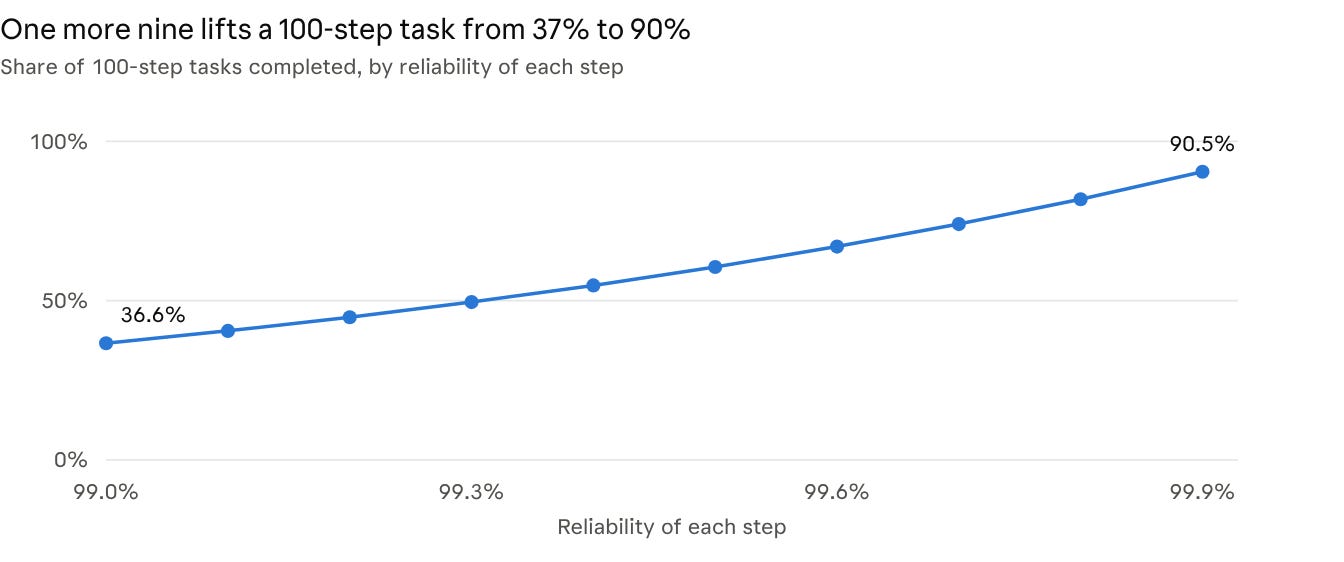
Long tasks are worse than big fleets. A task with 100 steps, each 99 percent reliable, finishes about a third of the time.
My claim: as intelligence gets cheap, raw capability stops being what limits its value. Three things take its place. Reliability: does it work every time? Interpretability: can we see why it failed? Steerability: can we set limits it will stay inside? Anthropic names the same three as its aim, and Andrej Karpathy calls the reliability problem the “march of nines.” What I add is how this gets paid for. Copies of one model fail together. Whoever carries that loss will pay to inspect and limit it. The profit goes to whoever supplies the proof.
three calls, stated first
Call 1: buyers keep paying more for models they can control. Menlo Ventures, an investor in Anthropic and OpenRouter, tracks enterprise AI spending. Its November 3, 2026 report says open-weight models, the ones anyone can download and run, handle 19 percent of enterprise usage, counted in tokens, and earn 4 percent of the spending. So closed models earn 5.6 times as much per token: (0.96 ÷ 0.81) ÷ (0.04 ÷ 0.19). Treat 5.6 as an upper bound: Menlo does not say whether running open models on your own hardware counts as spending. A year ago the ratio was 1.9. Most of the jump came from open models cutting prices 3.3x, and Menlo says buyers are paying for capability, not control. I am betting against my own source: in Menlo’s 2029 report the ratio is 3.0 or higher.
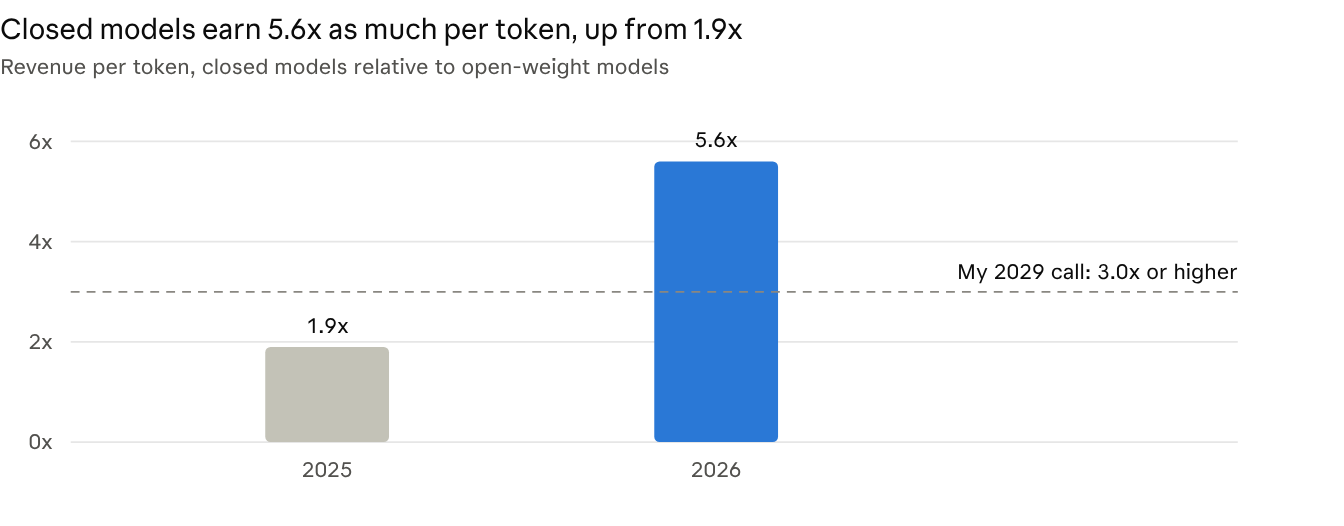
Wrong if: the 2029 ratio is below 3.0, or open-weight models pass 15 percent of spending in any Menlo report through 2029. Void if: Epoch AI’s headline price decline falls from 40x per year to under 10x. If Menlo stops publishing both shares, I name a replacement within 60 days or score a miss.
Call 2: aviation writes the limits into its rules. Europe’s aviation regulator, EASA, is writing rules for AI (task RMT.0742). Its second proposal is due for comment in Q2 2027. The September 2026 draft gives an operator two choices: check every AI output before using it, or prove the system works inside stated limits and keep monitoring it in service. The call: the stated limits and the monitoring are both still in the rules adopted by December 31, 2029. By that date EASA has certified no “Level 3B” system, its term for automation a human cannot override, in commercial air transport.
Wrong if: the adopted rules drop either requirement, a Level 3B system is certified, or nothing is adopted by the date.
Call 3: a major insurer asks for proof. A few specialty insurers already sell AI liability cover. The big insurers went the other way. Since January 2026, standard policy wording lets them exclude generative AI from general liability, and more than 60 insurance groups have filed on it. The call: by December 31, 2028, one of the ten largest US property and casualty insurers, ranked by premiums in the NAIC market share report, launches AI liability cover that requires outside proof about the AI system. Proof means a certification, an audit, or an evaluation report. Removing an AI exclusion on the same condition counts. Cover inherited through an acquisition does not.
Wrong if: no top-10 insurer does so by the date, or the first to launch sets its price on the customer’s revenue and industry alone.
why the constraint moved
AI at a fixed level of performance keeps getting cheaper: 40x per year on Epoch AI’s headline measure (trends page, updated February 5, 2026) and 13x on its broader one.
Chat hid the reliability problem, because a person read every answer and caught the errors for free. Agents that work alone remove that safety net. In METR’s 2026 results, the tasks top models finish 80 percent of the time are about 8 times shorter than the tasks they finish half the time. METR publishes nothing above 80 percent, and both figures come from one fitted curve, so the gap is an estimate. On τ-bench, a customer-service test, the best models solved fewer than half the tasks once and under 25 percent of retail tasks eight times running.
the three constraints
Reliability is about the worst cases, and the worst cases arrive together. Take 1,000 units that each fail 1 percent of the time. If they fail independently, you expect about 10 failures, give or take 3. Suppose all 1,000 run the same model and meet the same trigger. They fail as one. The average is still 10, but the outcome is either none or all 1,000. Same average, 32 times the spread.
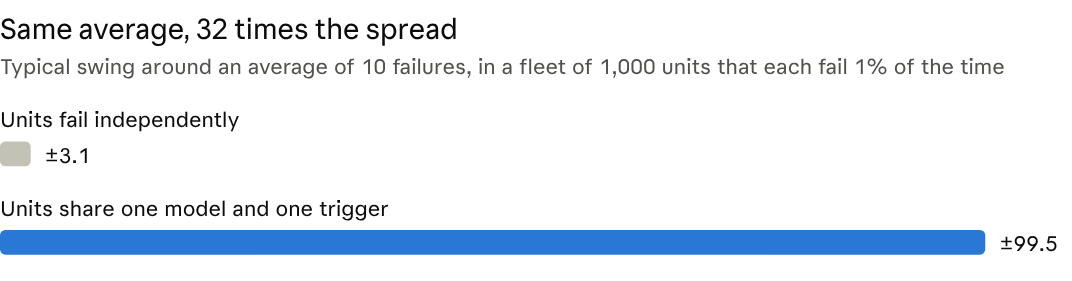
Real fleets sit between these two cases, and closer to the second. When two different AI models both get a question wrong, they give the same wrong answer 60 percent of the time, against 33 percent by chance (Kim et al., ICML 2025). Nine top models voting together were worth 2.18 independent votes (Kohli, 2026 preprint).
Interpretability means a tool outside the model. Anthropic’s 2025 circuit-tracing research found cases where a model’s explanation of its reasoning did not match what it actually computed. A system’s account of itself is not a log. You need an instrument that does not depend on the system being tested.
Steerability means a limit someone can enforce. Ashby’s law says a controller must be as flexible as what it controls. Institutions cope by handing over authority only inside limits they can state and check. A steerable model is one whose limits a compliance officer can write down, test, and show to an auditor.
Control costs money, and the cost varies widely. Anthropic’s safety filters added 23.7 percent to computing cost in early 2025 and 1 percent a year later.
what the market data shows, and what it does not
Menlo’s data shows Anthropic’s share of spending on AI models rising from 40 to 55 percent in a year. Ramp’s payment data from 85,000 businesses points the same way: Anthropic took 49 percent of AI token spending in early November 2026. But market share cannot tell a smarter model from one that finishes the job.
The stronger objection is that one product explains it all. Coding tools take $34.0 billion of the $77.3 billion spent on AI applications, and two products, Claude Code and Codex, take $24.0 billion of that. But why did coding go first? Because code comes with a cheap, independent checker already built in: the compiler, the test suite, the diff.
One observation would settle it. If product momentum explains the shift, the ratio in Call 1 falls as open models catch up on benchmarks. If control explains it, the ratio stays above 3.0 and the same companies lead in regulated work that has no built-in checker. That evidence does not exist yet, so outside software the control premium is a hypothesis.
the bet, and its rival
Anthropic is betting that you must understand a model before you deploy it. It has a policy that ties safety measures to capability levels, research into how its models work inside, a published constitution for the model, and a public report with each release. Every high-risk industry has the same list: a specification, an instrument, a test program, and failure analysis.
A June 2026 report from the reinsurance broker Gallagher Re says today’s AI evaluations were not designed for insurers, and do not show whether failures in a widely used model would hit many customers at once. Whoever turns lab evaluations into evidence an insurer can price owns the opening in Call 3.
Open-weight models are the rival path. A company can inspect them and run several at once, but it takes on the liability itself. If regulators and insurers accept a company’s own monitoring as proof, the profit moves to independent auditors, and Call 1 loses.
what I have measured, and what is missing
I hold labs to a standard I had to correct my own work to meet. Reckon Research is my personal measurement lab. It counts AI output only when it arrives on time and meets a stated quality bar. I call that a served token.
Exploratory. On November 9, 2026 I analyzed test runs of one open model, Llama-3-8B, on five AI chips: 30 settings per chip. I measured how far each chip fell short of the speed its memory hardware should allow. The typical shortfall ran from 17 percent on an L40S to 55 percent on an H100 SXM. On a single chip, the A100, the shortfall ranged from 24 to 77 percent depending on the setting, with a middle value of 27. One summary number hid that range. These are upper bounds: three chips were identified by their operator, and software versions differ across chips.
Measured. I tested the chips against a ceiling from my own benchmark. One chip beat that ceiling on all 30 settings. A chip cannot beat its true limit, so my ceiling was wrong: I had used a memory-copy test where a memory-read test belonged. It is logged publicly as Defect 17.
The audit trail. My predictions file and my first results went public in the same commit on November 9, with the predictions left blank. So on November 18 I relabeled the work exploratory.
Missing. My data stores one typical value per batch, so I cannot say what share of output arrived late. I have not measured quality at all. One published test shows the scale: under a tight speed target, a standard serving setup met it for 51 to 55 percent of requests (Kairos, 2026). The measurement note has my full evidence table. An instrument is worth exactly as much as its audit trail. Wrong if: rerunning my public data gives different numbers.
who wins
The lab that ships proof with the model. It sells evidence, stated limits, and failure analysis, and it keeps the premium in Call 1. Anthropic leads in published interpretability research. Its pledge to let outsiders test its models is unproven.
The independent auditor. Auditors, certifiers, and insurers turn lab evaluations into evidence an insurer accepts. Regulators already put the monitoring duty on the company using the model, which favors this group over the labs.
The loser is capability sold without proof: a model that scores well and cannot show why it failed.
what breaks this essay
Interpretability does not scale. Anthropic’s 2025 paper says its method gave a satisfying explanation for about a quarter of the prompts tried. If that share does not grow with model size, the tool stays in the lab.
Reliability comes free with capability. In METR’s data, reliable task length doubles as fast as average task length. If new models fix the worst cases without anyone understanding how, the premium goes to zero.
Limits stay statistical. If written principles produce “usually complies” and never “cannot exceed,” physical infrastructure will not accept them.
A power grid or a hospital cannot use intelligence it cannot inspect or limit. Legibility is the interface between cheap intelligence and expensive consequences.
sources
Primary.
Menlo Ventures, 2026: The State of Enterprise AI, November 3, 2026. The 5.6 and 1.9 ratios are my arithmetic from its shares. Cross-check: Ramp AI Index, data through November 1, 2026.
METR: Frontier Risk Report, May 19, 2026, Measuring AI Ability to Complete Long Tasks, and the time horizon limitations note, January 22, 2026.
Correlated failure: Kim et al., Correlated Errors in Large Language Models, ICML 2025 and Kohli, Nine Judges, Two Effective Votes, May 2026.
Cost of control: Anthropic, next-generation Constitutional Classifiers.
Epoch AI trends page, price trends post, and The Plunging Price of Thought.
Anthropic: company page, Tracing the thoughts of a large language model, On the Biology of a Large Language Model, Responsible Scaling Policy, and Claude’s Constitution.
EASA: terms of reference for RMT.0742 and the AI Days rulemaking update, September 2026.
Reckon Research: defect register, Defect 17 and the mismatch-tax repository, first commit ad10987 (November 9, 2026), relabeled in 9484795 (November 18, 2026). Per-configuration traces are retained in data/measured.
Secondary.
ISO exclusions and filings: Big I and The Insurer, July 23, 2026.
Specialty AI liability cover: Insurance Thought Leadership.
The march of nines: Andrej Karpathy on the Dwarkesh Podcast, October 17, 2025.
EASA Level 3B: Aviation Week.